
A direct line to the nervous system
Conscious connected breathing bypasses the thinking mind. It shifts blood chemistry, changes what the body considers safe, and reaches material that words rarely touch. It is also the one tool you keep afterwards.
Ceremonial retreats rooted in sound, breath and expanded consciousness, for those who are done managing themselves and ready to meet what lies underneath.
You are invited to meet yourself with honesty, courage and compassion, and to arrive exactly as you are, carrying whatever you carry.
Perhaps something has been hurting for a long time and you have run out of ways to think your way out of it. Perhaps you want clarity about a direction. Perhaps you want to meet your own patterns without flinching. Or perhaps you simply want to feel yourself more deeply than an ordinary week allows.
We work through breath, sound and presence, in a room that is deliberately small. Nothing here asks you to perform, believe anything, or become someone else by evening.
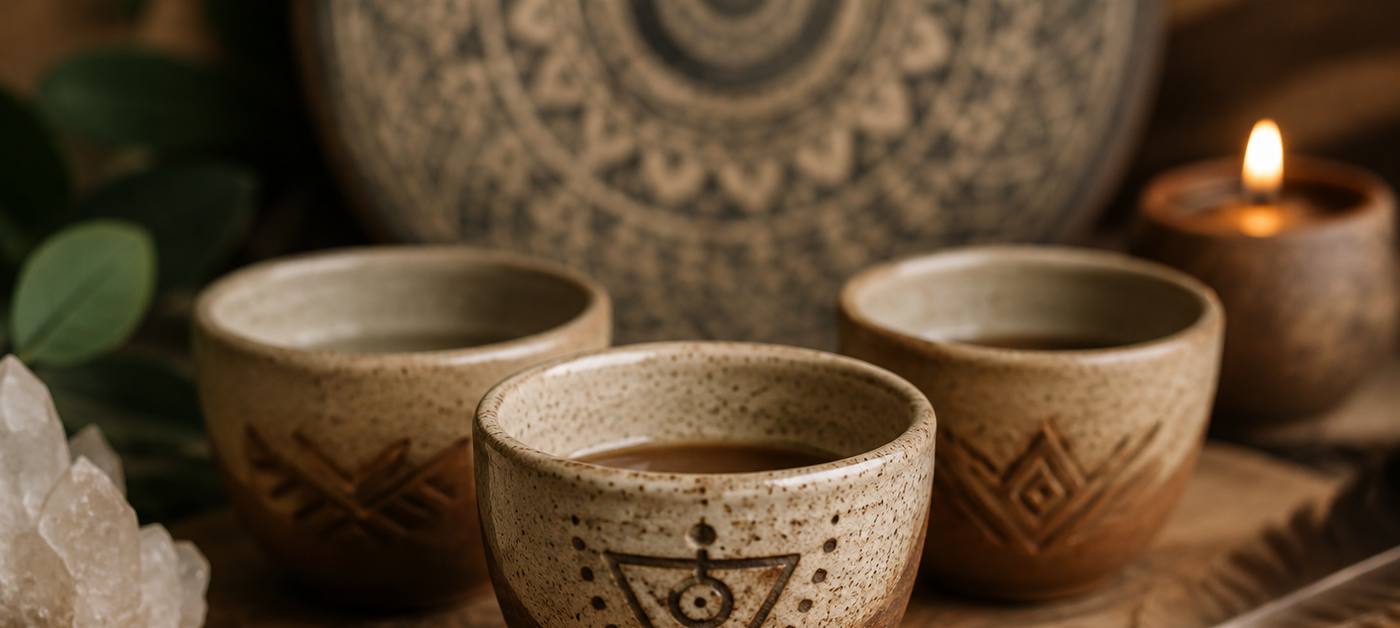
Not ready for a gathering, or drawn to the breath rather than the ceremony? We hold breathwork on its own, one to one or with a group. We also work privately.
Research into consciousness, the nervous system, altered states and mental health is moving quickly, and much of it is less settled than the headlines suggest. We keep a separate library where we follow that work honestly: what has been shown, what has not, and what nobody knows yet.
It is an educational resource, kept deliberately apart from anything described on these pages.
Most of what happens is not taught. It is arranged: the room, the order of things, the sound, the pacing of the nervous system, so that something can surface on its own.
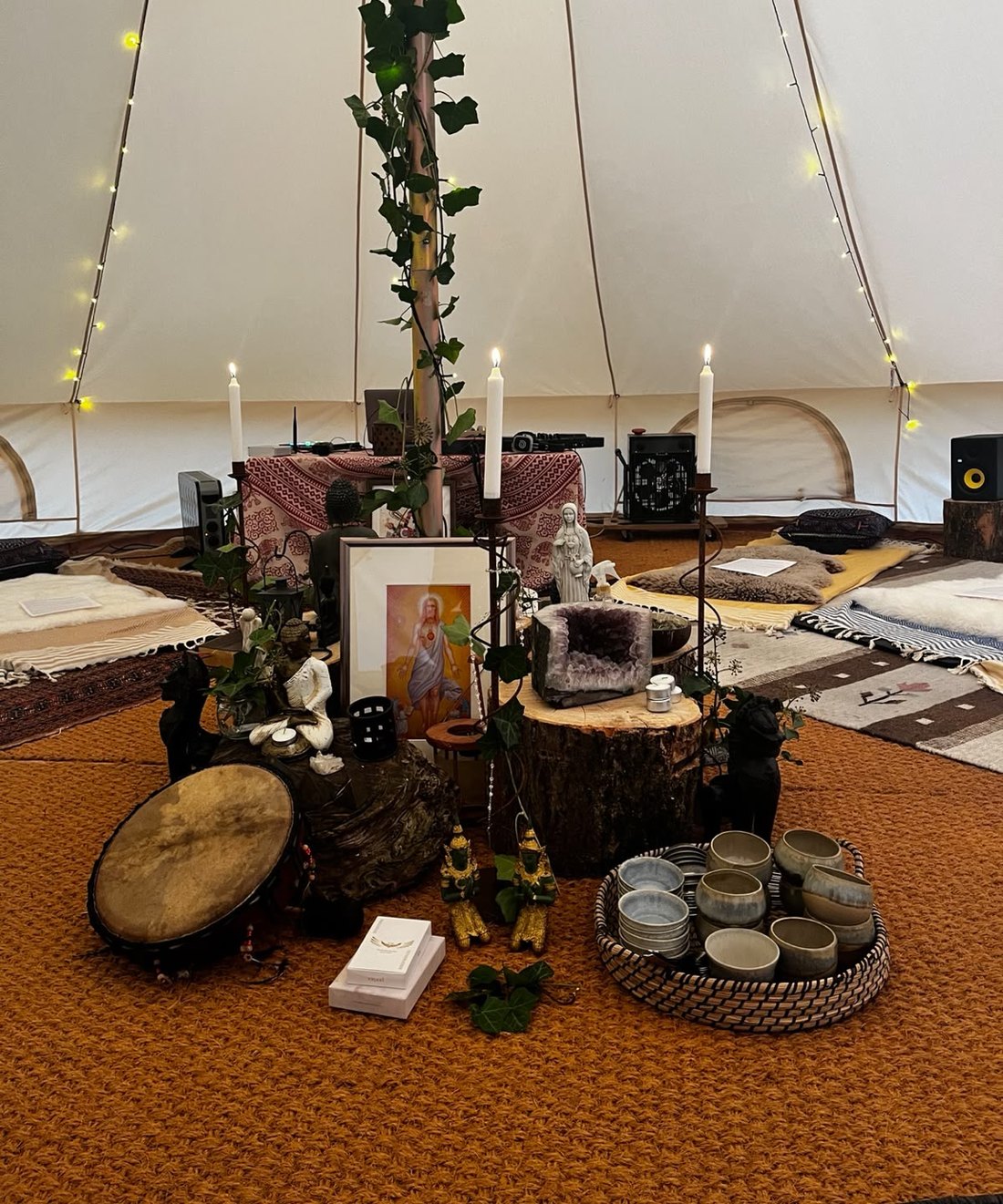
Conscious connected breathing bypasses the thinking mind. It shifts blood chemistry, changes what the body considers safe, and reaches material that words rarely touch. It is also the one tool you keep afterwards.
Hours of sound built in the room, responding to what the group is doing. Music organises emotion in a way instruction cannot. It gives feeling somewhere to go.
Nothing deep opens in a body that is bracing. The first hours are entirely about the nervous system settling enough to stop defending. The rest depends on it.
The closing sauna ritual is not a reward at the end. Heat, aroma and cold give the body a physical way to metabolise the experience, so insight lands somewhere other than the head.
Our role is to create and hold a safe, grounded, structured container. We guide, support and anchor the space, so that you can explore what arises with as much safety, presence and care as possible. We are not here to lead your experience, but to support you in meeting your own.
Your role is simple and demanding at once: to show up with honesty. To stay present with what arises. To be willing to feel, to listen, and to stay curious toward your own experience.
We trust the process, and we trust you. Your body, your nervous system and your awareness know where you need to go.
A journey through the layers of consciousness: from earthbound to open, from stillness to intensity and back again.

Some of our gatherings include an optional ceremonial element. It is never described publicly and never assumed. It is discussed with you personally, one to one, before you decide whether to register.
The same work, at four depths, from a single day to a week away. Everything begins with a personal conversation, so the format fits the person rather than the other way round.
Looking for private work, or bringing your own small group? That now has its own place under Individual journeys.
Composed like a piece of music: a long arrival, a gradual opening, a peak that is earned rather than rushed, and a slow, careful landing.
Intensity across the day
You arrive, put your things down, and settle into the space. A private one-to-one conversation with a facilitator, for alignment and safety.
Welcome, intention and smudging. A space without masks or performance. Here we land.
Stillness, warm tea, and the last settling before the journey inward.
The breath takes us down into the body's own intelligence, to the layers where both wound and strength are stored.
Composed in the room, in four movements. The heart of the day. Blindfold and blanket; you stay lying down for as long as you want to.
Fruit, nuts, tea. Simple food is part of the coming back.
Gentle, intuitive movement so the body can say what the mind has not yet found words for.
Warm, nourishing food shared in quiet company. Conversation optional.
Grounding, reflection, and a proper closing of the ceremonial space together.
Heat, aroma and elemental cleansing. The last thing we do together, so the body carries the day home rather than the head.
Yoga mats, snacks and tea are available on site. You are welcome to bring a meaningful personal object for the altar.
Almost everyone arrives with a version of but what if… Here are the ones we hear most, answered plainly. If yours isn't here, ask it. We would rather have the conversation than have you guess.
Then you cry.
Tears are welcome here. They're also very common.
In an altered state of consciousness, emotions can come closer to the surface, sometimes without a clear story attached to them. You may cry from sadness, relief, tenderness, fear, gratitude, or for reasons you can't quite put into words.
You won't be asked to explain it, pull yourself together, or make it mean something.
The people around you are on their own inward journeys, and our facilitators are there to hold the space and support you if you need it. Sometimes that means being close. Sometimes it means giving you room.
And often, something shifts when we discover that we can be deeply moved in the presence of others without having to hide it.
So if the tears come, they're allowed to come.
Sometimes it is quiet. A tired nervous system will often choose rest over revelation, and that is a legitimate outcome rather than a failure.
People who feel little on the day frequently report that something shifted in the following two weeks. We build the integration support around exactly that.
You say so, and it stops. Everything is invitational. You can pause, sit up, leave the room, or ask a facilitator to sit with you.
Panic is not an emergency here; it is information. Someone stays with you until your system settles, for as long as that takes.
You are always responsible for your own boundaries and choices. Our role is to support and guide, not to override your inner knowing.
This is the most reasonable fear on the list. Difficult material does come up, and that is partly the point. The day is structured so that it does not come up alone.
Groups are kept small enough that a facilitator can be with you individually. Nothing is opened at the end of the day when there is no time to close it. And you leave with a contact, not just a goodbye.
If you are currently in acute crisis, this setting is not the right container. Write to us and we will say so honestly.
Good. There is nothing to believe in here. The breath works on physiology, the sound works on the body, and neither requires a worldview.
People arrive from engineering, medicine, construction and finance as often as from yoga rooms. Scepticism is welcome and it does not interfere.
Then you don't. Sharing in circle is offered, never required, and passing is completely ordinary. Several people do it every time.
The only conversation we do ask for is the private one-to-one beforehand, and that one is for your safety.
Tell us before you register, not after. Write to us if you are pregnant, taking psychiatric medication, living with a heart condition, epilepsy, or a history of psychosis.
This is not a formality. Some of these mean we adapt the container to your needs; some mean we will honestly tell you this is not the right setting right now. We would rather lose a registration than take a risk with you.
Everything you share is treated with full confidentiality and care.
Tell us in advance and we will place you thoughtfully. Some people go deeper with a familiar person nearby; others need distance from anyone who knows their everyday self.
What is said in the room stays in the room. That is stated plainly at the opening circle and it is taken seriously.
Please plan not to. The last hours are where the day is closed properly, and leaving mid-journey means leaving something open.
If you have a hard constraint, say so beforehand and we will decide together whether this date works for you or whether a later one is better.
A single day does not rebuild a life, and anyone promising that is selling something. What a day like this reliably does is show you something you had stopped being able to see.
What happens next depends on what you do with the following weeks. That is why preparation and integration are part of the offer rather than an upsell.
How you arrive shapes what is possible. What you do in the following weeks decides what lasts. Both are part of the work, not preparation for it.
To support a safe and grounded experience, we ask that you arrive well-rested and with as few outside commitments as possible on either side. Give yourself space to land, both going in and coming out.
Plan your transport in advance so you can arrive and leave without stress, and come a little early to let your body and nervous system settle before we begin. Eat lightly on the day, and avoid alcohol or other substances for at least 24 hours beforehand. Staying hydrated and nourished in the days leading up supports your body through the process.
Participation in every practice is always an invitation. You can pause, ask for support, stay still, move gently, or simply breathe. This is a phone-free space, and everything shared within the group is held in confidence, so that everyone can show up honestly.
Give yourself a quiet evening and an unhurried next morning. Insight tends to keep unfolding slowly for a fortnight. Don't make large decisions in the first days.
Everyone who joins receives a written integration guide, a follow-up message in the week after, and the option of a one-to-one integration conversation.
Integration is not a spiritual concept. It is the ordinary, sometimes tedious work of translating something that happened in an unusual state into how you actually live on a Tuesday.
If you are pregnant, taking psychiatric medication, living with a serious heart condition, or currently in acute psychological distress, please write before registering so we can talk honestly about whether this setting supports you right now.
You can select more than one gathering in the same registration. We confirm your place personally afterwards, and payment happens on the day itself, so you can secure a place now without committing money.
Not sure yet? Read the questions people ask first, or ask us for a free conversation using the form below.
The full fee is paid in cash when you arrive. We have chosen to keep the process simple and ask for nothing in advance.
If you need to cancel, please let us know at least one week before. That gives us the chance to offer your place to someone else.
Cancellations made less than a week before, or not showing up on the day, still require full payment. This is in respect of the time, energy and preparation that goes into holding the space, and of the limited number of places. We appreciate your understanding and integrity around this.
If you are unsure which side you are on, that is a good reason to ask for a conversation rather than to register.
A day is a door. What follows is the part that changes a life, and it happens in ordinary weeks, at home, without anyone holding the space for you. These are here for that stretch.
These are taken from real gatherings, composed live in the room. They are not a substitute for being there, and they will not take you as deep, because half of what happens in the tent is the other people breathing beside you.
What they can do is give you a way back. Lie down somewhere dark, use headphones, give it the full length rather than sampling it. Something in the body remembers.
Three hours of music. One continuous passage.
Not a collection of tracks, but a carefully shaped descent through different layers of feeling, perception, tension and release.
The music within this journey has been gathered slowly, over time. Many of these pieces found their place through inner pilgrimages and ceremonial spaces, retreats and therapeutic sessions: moments where music was allowed to accompany people into deeper and sometimes unexpected territories within themselves.
Over time, certain tracks kept revealing something. Some opened doors. Some created movement. Some brought resistance or unease. Some carried people toward tenderness, grief, wonder or release. And some simply created the space that allowed whatever came next to be felt more deeply.
This journey grew from those experiences.
It is not designed simply to be beautiful.
It is designed to move.
Unlike a conventional playlist, where one track ends and another begins, this mix has been created as one continuous, fluid movement.
Tracks dissolve into one another. Moods gradually transform. One emotional landscape quietly becomes the next.
There are no repeated moments of stopping and starting, and ideally there comes a point where you stop noticing individual tracks altogether.
The music becomes a current. Something you can enter and allow yourself to be carried by, without needing to know where it is going next.
This continuity is an essential part of the journey.
The journey has an intentional emotional architecture. Some passages invite you inward. Some provoke. Some create spaciousness, while others become denser, darker or more uncertain. Some are deliberately restrained, repetitive or even slightly dull.
Nothing is there only to be pleasant.
Contrast is part of the composition. A restrained passage can allow the senses to settle. Darkness can make warmth more perceptible. Tension can make release more profound. Simplicity can prepare the ground for beauty.
The journey gradually descends beneath the familiar layers of the self, moving through different colours of emotion: shadow and light, tension and surrender, intimacy and vastness.
There is a build, but not simply toward intensity. It is a build toward depth.
Eventually the music reaches its peak, where the emotional landscape becomes fuller and the boundaries between listening, feeling and experiencing may become less distinct.
Then, gradually, the movement changes. The music begins to bring you home. Warmth returns. Space opens. Familiarity slowly reappears. The ground comes back beneath your feet.
In our sessions and ceremonies we traditionally begin with approximately thirty minutes of guided breathwork. The breathwork serves as an initiation into the experience, a transition from ordinary activity into a quieter and more receptive state of attention.
Rather than beginning the music immediately after the noise and movement of everyday life, this first half hour creates a threshold.
A moment to arrive. A moment to notice the body. A moment to turn inward.
The complete arc was conceived with this rhythm in mind: approximately thirty minutes of arrival through breathwork, followed by three hours of uninterrupted music.
The guided breathwork is free to download, and it is spoken in Danish. Open the breathwork recording.
If this mix is used as part of an inward journey, the central idea is very simple.
Let the music come to you.
In psychedelic research settings, participants are commonly invited to lie down, wear eyeshades and listen to music through headphones. The purpose is to reduce external stimulation and encourage attention to move inward rather than toward the surrounding room.
You may choose to approach this mix in the same spirit: somewhere physically comfortable, with minimal interruption, allowing the outside world to become less important for a while.
There is no need to understand the music. There is no need to follow every sound. And there is no need for every passage to feel beautiful.
If something feels strange, melancholic, challenging or unresolved, it may simply be part of the larger arc.
Allow the next landscape to arrive.
Music is not merely decoration around an inner experience. Research into psychedelic-assisted therapy has treated music as an important component of the setting, and studies have described its capacity to evoke emotion and imagery, provide a sense of guidance and continuity, and support inward attention.
Importantly, the relationship is not always comfortable. Music can evoke difficult emotions and resistance as well as feelings of safety, openness and meaning.
That is part of what makes its role interesting. The intention is not necessarily to make every moment pleasant, but to create an emotional container capable of moving through very different territories.
For this reason, the music in this journey has been selected not track by track in isolation, but according to what each piece contributes to the passage as a whole.
Sometimes music leads. Sometimes it holds. Sometimes it unsettles. Sometimes it almost disappears.
And sometimes it arrives at exactly the moment when something inside is ready to open.
If you want the research behind this, it is gathered under Sound, breath and the body.
The combination of eyeshades and immersive music is also intentional. Removing much of the visual world can change the direction of attention. Rather than continuously orienting toward the room, the people around you or external objects, there is more space for imagery, memory, emotion and bodily experience to become foreground.
The music then becomes one of the primary elements moving through that inner space.
Not a soundtrack playing beside the experience. Part of the experience itself.
This mix grew partly from therapeutic and ceremonial environments, where preparation, setting and human support are considered important parts of the experience.
Clinical psychedelic research likewise does not generally consist of taking something, putting on headphones and being left alone. Participants are typically screened and prepared beforehand, and trained monitors or therapists remain present throughout.
If you choose to work with altered states outside such a setting, the existence of this mix should not be understood as a substitute for appropriate preparation, support or professional care.
The music can hold a thread.
It cannot replace a human being when a human being is needed.
Some people are screened out of clinical research before anything begins, and the reasons are good ones.
They are worth knowing before you plan any inward journey of your own, whatever form it takes. None of this applies to listening. It applies to what some people choose to do alongside it.
The clearest one. Case reports have repeatedly described seizures and other severe reactions when lithium is combined with psychedelics. This is not a risk to weigh against the experience. If you take lithium, the answer is no.
Bipolar I disorder, or a personal or family history of psychosis or schizophrenia, are standard exclusion criteria in trials. An altered state can precipitate an episode in someone already vulnerable to one. A family history counts even if you have never had symptoms yourself.
Antidepressants, mood stabilisers, tramadol and a number of other prescriptions interact, in ways that range from quietly blunting the experience to being genuinely dangerous. Never stop a prescribed medication on your own in order to make room for something like this. Stopping is its own risk and often the larger one.
Serious cardiovascular conditions, uncontrolled high blood pressure and pregnancy are standard exclusions too.
If any of this applies to you, the music is still yours. Three hours of listening asks nothing of your body and carries none of these risks. It is only the rest we are talking about.
And if you are unsure where you stand, that is a conversation for a doctor rather than a forum.
Ultimately, there is nothing you need to accomplish here. This journey is not designed to tell you what to feel, what to discover, or where you should go.
It is an invitation to listen inward.
To make room for darkness as well as light. Resistance as well as surrender. Stillness as well as movement. Grief, tenderness, uncertainty, beauty, emptiness, intensity, warmth.
And perhaps, for a few hours, to stop choosing what should come next.
Let one piece become another. Let one feeling become another. Let the journey unfold.
Thirty minutes to arrive.
Three hours to journey.
One continuous passage inward and home again.
People have always looked for ways to step out of the familiar and into other layers of consciousness.
Through ritual, silence, breath, meditation, sound, nature and psychedelic substances, people have explored the inner landscape, not only to find answers but to meet what normally lies outside our ordinary field of vision.
At The Inner Pilgrimage we see this kind of experience as exactly that. A journey inward.
Not a shortcut.
Not a promise of healing.
And not an experience that has to be beautiful or comfortable.
But a space where our usual way of experiencing ourselves and the world can change, where feelings, memories, patterns, relationships and existential questions can step forward in new ways.
Some meet great love and connectedness. Others meet grief, fear or old parts of themselves. Some meet silence. Others meet something that words can barely hold.
There is no one correct journey.
There is the journey that unfolds.
That is why our understanding of this work begins before the journey and continues long after it. We work with three movements.
Before anyone steps into an altered state of consciousness, the work is about building a foundation.
What brings you here?
What is taking up space in your life?
What do you long to understand, to meet, or to move closer to?
An intention can be valuable, but it is not an order placed with the experience. We can set a direction. We cannot decide in advance what the inner landscape will show us.
So preparation is also about safety, relationship, expectations, boundaries and about sensing whether the time is actually right.
Once the journey begins, the work changes character.
Here it is less about understanding and more about being with what arises.
The breath can become an anchor. The music can open landscapes. The body can tell its own story. And what existed only as thought can suddenly be felt.
Our role is not to decide where your journey should take you. We hold the space around it, with presence, calm and respect for the fact that it is your experience.
When support is needed, it is there. When silence is the right thing, silence is allowed to do the work.
And then you come back.
Perhaps with clarity. Perhaps with questions. Perhaps with something that has not yet found words.
This is where integration begins.
Because the real meaning of an inner journey is not necessarily found in the hours when consciousness is changed. It usually shows itself afterwards: in the relationships, the body, the choices, the boundaries, the way we meet our ordinary life.
How do I live what I have seen?
What do I actually want to change?
And what does not need changing, only understanding differently?
Integration is not about holding on to a particular state. It is about letting the experience find its place in a human life.
A pilgrimage is not only about arriving. It is also about the one who comes home.
So for us the potential in this work does not lie in escaping ordinary life, but in returning to it with a little more presence, a little more honesty and a deeper contact with what actually matters.
Some journeys change something fundamental. Others simply plant a small seed. Both can matter.
The Inner Pilgrimage is an invitation to go inward, then to carry what you find back out into your life.
You are considering spending a day in a room with us. You should know who we are before you decide.
There are three of us and we hold every gathering together. Nobody is ever the single point of attention and nobody is ever left unattended.
That matters more than it sounds. If one person needs something during the day, someone can sit with them without the room losing its centre. Three people also means three readings of the same moment, with enough disagreement between us to catch what one of us alone would miss.
We come at this from different places and we do not always see the same thing in the same way. We consider that a feature.
Stefan came to this work through music. For years he travelled as a trance DJ, shaping the energy of a room with sound and rhythm. Night after night of that is an education in what music does to a group. That work was about lifting people up and taking them out. At some point it stopped being what he wanted to do. The same understanding aimed differently turns out to be about helping people come back down: into the body, into safety, into whatever they had been moving fast enough to avoid.
His own practice keeps him grounded. Yoga is a steady part of his life and meditation is something he keeps returning to with love and curiosity. He still makes music, now composed for breathwork journeys and psychedelic-assisted music therapy, where sound becomes a quiet companion rather than a peak.
During the ceremonies you will find Stefan guiding the journey through music. Before anything begins, he sits down with each participant for a personal one-to-one conversation, so everyone can enter the experience feeling met and at ease.
Stefan doesn't see himself as someone with answers. He holds space, shares what has helped him and walks alongside people while they find their own way back to themselves.
Tinamaria is a mother of two teenagers, a trauma-informed bodyworker and facilitator with a deep curiosity for what lives beneath the surface.
Her approach is rooted in the body, in presence and in a trust in the wisdom we carry within us. Through de-armouring, somatic bodywork, breath and intuitive touch, she creates spaces where we can slow down, soften and listen more deeply to what is alive.
Nature grounds her: the forest, the ocean, warmth, silence and the changing rhythms of the seasons. It reminds her that our own inner processes have their own timing too.
Aliveness is woven into the way she experiences life: in the body, in movement, in pleasure and in the ability to truly feel.
In the ceremonies she holds a grounded, embodied presence, supporting you in feeling safe enough to soften while inviting you to meet the places within that long to move, open and come alive. She brings her trauma-informed experience with the body, nervous system, touch and integration into the space, trusting each person's own journey.
She also facilitates somatic movement around the ceremony itself. Beforehand it is a way of landing in the body. Afterwards it becomes part of integration, letting what moved during the day settle into the body rather than staying in the head. When the day closes she holds part of the space in the sauna alongside Søren, which is the last piece of that same integration.
For her, the inner journey is not about becoming someone else. It is about coming home to more of who we already are.
Søren is 53, self-employed and father to two grown daughters who have both left home. He runs Soma Sauna Gus from his garden in Gedved, which is where the gatherings are held.
During the ceremony he stays mostly in the background, keeping the frame around the space so the others can hold what happens inside it.
His part becomes visible when someone needs to step out. Sometimes the journey gets too much, too fast, or simply needs a pause. Then he is the one who sits with you somewhere quieter, without pushing you back in or asking you to explain. You breathe. You slow down. Your system settles until you know what you need next.
When the day closes he holds part of the space in the sauna. Heat, aroma and cold help the body take in what the day has opened. He keeps it calm, gentle and at your pace. Nothing to perform there, only warmth and room to land.
He trained as an Enneagram Master Practitioner, which gave him NLP tools and an understanding of the nine types. Mostly it taught him to meet people where they are, which in moments like these is the only thing that matters.
Everything begins with a conversation. That conversation is as much for us as it is for you, so that together we can work out whether this is the right setting for you at this point in your life.
No ceremony. Nothing added. The breath on its own, held properly, for as long as it takes.
Almost everything we do begins with breath. It is how a room arrives, how people step out of the thinking mind into the body, how a nervous system is persuaded that it is safe enough to stop holding on. At our gatherings it is the threshold before anything else begins.
Some people come to us and discover that this part alone was what they were looking for.
So we offer it on its own. Conscious connected breathing, guided long enough and carefully enough to actually take you somewhere. What happens there is not a smaller version of the deeper work. It is its own thing, with its own reach.
People come to this for two different reasons. Both are good ones.
The first is to find out what their own body does before going any further. If you are considering the deeper work with us, breathwork answers an honest question first: how do you respond when the ground moves a little? Do you brace? Can you let go? What arrives when nothing is left to distract you? You find that out with a facilitator beside you, in a state you can step out of at any point, with nothing in your system but your own breath. For a lot of people this is the right way to begin.
The second reason is simpler. For some people this is the work. They keep returning to the breath for months or years and never feel a pull towards anything beyond it, because it keeps giving them what they came for. That is not an unfinished version of something else. Nobody here will be nudging you towards a ceremony.
A session runs a couple of hours. We talk first, properly, because what you are carrying changes how the session is guided. Then you lie down and we begin. The breathing is active to start with, building gradually, with rounds of retention along the way. It can become intense. It can bring up emotion, sensation, memory, shaking, tears, or a stillness you were not expecting. None of that needs managing. It needs company, which is what a facilitator is for.
Afterwards we leave time. The breath does its clearest work in the quiet that follows. That part is not something to walk out of early. We talk again before you leave. If something wants following up, that is what the next conversation is for.
Something happens in a room of people breathing together that does not happen alone. Sound carries further. Permission spreads. One person letting go makes it easier for the next one.
We hold group breathwork for circles that arrive already formed: friends, a family, a community, people who train or live alongside each other and want something more honest than another evening of talking about it.
The music is composed live in the room rather than played from a list, which means the sound follows the breath instead of the breath following the sound. That is the part most people remember afterwards.
A group can be small enough for a living room or large enough to need a hall. Tell us the people and the room and we will say honestly whether it fits.
These sessions carry no ceremonial element. Breath, sound, a held space and time to land. They suit people who have never done anything like this as well as people who have done a great deal.
No experience is needed. You do not have to be fit, flexible, spiritual or any good at meditating. If you can breathe, you can do this.
There are conditions where strong breathwork is not appropriate or needs adapting: pregnancy, epilepsy, cardiovascular conditions, high blood pressure, glaucoma or a detached retina, recent surgery, a history of psychosis or bipolar disorder, among others. That is not a reason to stay away without asking. It is a reason to tell us beforehand, so the session can be built around it or so we can say honestly that something else would serve you better.
We are not doctors or psychiatrists and we do not present ourselves as either. What we offer is a carefully held space and experienced company through an unusual state. If something surfaces that needs professional support, we will say so plainly and help you find it.
There is a 27 minute guided breathwork you can play or keep, free of charge, currently spoken in Danish. It is the same practice we open our gatherings with. It will give you a fair sense of what this is before you decide to meet anybody.
A private one to one session is 1.200 DKK. Group sessions are shaped around the group, so what they cost depends on how many of you there are and where it is held. We work that out in the conversation.
You can put a session down on the registration page alongside everything else we hold. Nothing is paid when you book.
You do not need to know which kind of session you want.
Tell us whether you are asking for yourself or for a group you already have, plus a little about why the breath is what you are drawn to. From there we talk, which costs nothing and commits you to nothing.
Not every inner journey belongs in a group.
For some, the right place to begin is somewhere quieter, with more privacy, more time, and the undivided presence of a facilitator. For others, private work offers the possibility of going deeper into something already unfolding, without having to follow the rhythm of a larger retreat.
Our private sessions are created around the person rather than around a fixed programme. The pace, preparation and form of the journey can be adapted to where you are, what you are carrying, and what you would like to explore.
You can come for a single private journey, or we can create a longer process together, moving slowly, building trust and allowing each experience to inform the next.
Looking for breathwork on its own, with no ceremonial element? That has its own page, covering one to one sessions as well as groups.
A private journey begins before the day itself.
We first meet for a conversation where there is space to get to know one another and speak openly about what brings you here. We explore your intention, your expectations, previous experiences and anything that feels important for us to understand before deciding how to proceed.
Sometimes the intention is very clear. Sometimes there is simply a feeling that something wants attention. Both are enough.
From there, we shape the journey together.
On the day itself, there is no need to rush into the experience. We begin by arriving, talking and creating a sense of safety and orientation. As with our retreats, we often use breathwork as a way of moving out of the thinking mind and gently into the body before the deeper inner work begins.
From there, much of the day is simply about allowing the journey to unfold.
Your facilitator remains with you throughout. At times that may mean conversation, guidance, grounding or support. At other times it means giving you the space to be completely inside your own experience while somebody quietly holds the container around you.
When useful, we also journal along the way, noting words, insights, questions or moments that arise and might otherwise disappear as the experience changes. These notes can later become valuable threads for integration.
There is no fixed ending.
We allow time for you to return gradually. Depending on the day and what feels right, we may sit together over food, spend some time in the sauna, walk, talk, or simply let things become quiet again before we part ways.
The journey is not considered finished when you leave.
A few days afterwards, we reconnect and begin making sense of what emerged. A further integration conversation gives us the opportunity to return to the experience once some time has passed and explore how it might find a place in your everyday life.
Some people are not looking for a single experience. They are looking for a process.
Private work allows us to create a more gradual pathway in which we meet over time, establish trust and work with what emerges rather than trying to reach somewhere quickly.
We might begin gently, learn how you respond to the work, integrate what arises and only then decide what the next step should be. Later journeys can build upon earlier ones, allowing the process to deepen at a pace that feels appropriate.
This can also include conversations and coaching between journeys, so that the work is not limited to the experience itself. Patterns, relationships, decisions, fears, changes and insights can be explored over time.
There is no predetermined number of sessions and no requirement to continually go deeper. The process develops through conversation.
Inner work does not only happen through words.
For those who want it, private sessions can also be combined with trauma-informed de-armouring and bodywork as part of a wider process of working with sensation, tension, boundaries and embodied awareness.
De-armouring is a body-based approach that invites us to meet the body with presence, curiosity and care. Rather than forcing a release, the intention is to create a safe and supportive space where the body can soften in its own time and begin to let go of tension, holding patterns and protective responses that may no longer be needed.
At the heart of this work is a trust in the body's own intelligence: that when enough safety, presence and support are available, the body has an innate capacity to regulate, reorganise and move towards greater balance and wholeness.
This can be especially supportive as preparation for an inner journey. Coming into contact with the body beforehand can create a deeper sense of grounding and safety, making it easier to arrive, soften and move inward. De-armouring can also be offered as a separate session, or as part of a longer, individually tailored process.
Bodywork and de-armouring are always discussed beforehand and approached with clear communication, consent and respect for personal boundaries. Nothing is assumed simply because it is available.
For some people, beginning with the body creates a very different doorway inward, allowing the inner journey to unfold from a place of greater presence, safety and embodied awareness.
There is something powerful about travelling alongside others, which is why group ceremony remains at the heart of The Inner Pilgrimage.
But it is not always the right beginning.
You may feel more comfortable exploring vulnerable material without other participants present. You may need more time, more individual attention or simply a quieter environment. You may be curious about this kind of work but not yet feel ready to enter a group ceremony.
A private journey can be a gentle first encounter before joining one of our retreats later. It can equally be a place for deeper individual work when a group setting would not offer the space you need.
Neither is considered more advanced than the other. They are simply different containers.
We also create private ceremonies for small groups.
You may already have the people you want to journey with: close friends, partners, family members or a small circle who would like to share the experience together.
Rather than joining one of our scheduled retreats, we can build the day around your group.
We meet beforehand to understand who is coming, what brings you together and what kind of experience you are looking for. From there, we shape the setting, preparation, breathwork, ceremony, food, integration and surrounding elements specifically for your group.
Some groups come with a shared intention. Others contain several individual journeys happening alongside one another. Both can have their place.
What matters is that the container fits the people inside it.
You do not need to know exactly what kind of session you need before contacting us.
In fact, we would rather you didn't try to design the journey alone.
Tell us a little about where you are, what is calling you towards this work, and whether you are considering something private or bringing a small group.
From there, we begin with a conversation.
No commitment. No predetermined journey. Just an opportunity to meet, ask questions and discover whether this feels like the right place to begin.
 For those who have been
A gathering lasts a day, or a weekend. What it opens takes considerably longer, and most of that happens at home, in ordinary weeks, with nobody holding the space for you.
People who have sat in the same room understand something about that stretch which no facilitator can supply. Not advice, and not interpretation. Just the ordinary reassurance of someone who was there, saying that what you are going through is what tends to happen.
Buddhist communities have a word for this: sangha, the company you practise alongside. The idea is older than any of us and it does not belong to us, but the need it describes is exactly the one that shows up three weeks after a gathering.
This page is about what participants can offer each other. What we offer is set out under Before and after, and what you take home is under Between gatherings.
The most useful version of this needs no website and no permission. It needs two or three people and a date in the calendar. Everything below is what we have seen work, and what we have seen go wrong.
Not ten. Small enough that everyone speaks and nobody hides. Groups of two or three survive; large ones become an audience and then go quiet.
Exchange numbers on the day and agree the first date then, while the room still feels real. A group formed a fortnight later almost never happens.
Half an hour every two weeks beats three hours once. Put it in the calendar as a standing arrangement rather than something to organise each time.
A call or a walk, not a message thread. Tone survives a conversation and does not survive typing, and it is tone that tells you how someone actually is.
Say it plainly at the first meeting rather than assuming it. What is said stays between you. Nothing is repeated to partners, and nothing is written anywhere public.
The temptation is to keep retelling the experience. The useful conversation is about Tuesday: what you did differently, what you avoided, what came back. Integration happens in ordinary life or it does not happen.
Resist explaining what someone's experience meant. Ask what it was like and let them find the meaning. Well-intended interpretation is the most common way these groups go wrong.
Peer support is not therapy. If something surfaces that is bigger than the group, say so kindly and help each other find a professional. Being the person who says that is a form of care, not a failure.
Most of these fade after a few months, and that is not a failure either. It served the period it was needed for. You can always call again later.
Any private channel works. Signal is the one we would suggest, because it is private by default and leaves no public trace. If you use something else, keep the group closed and do not post about it publicly.
Nothing here exists yet. If we do build something, it would go in this order, and each stage only if the one before it is actually being used.
A private group for each gathering, so the people who sat together can keep talking afterwards. Small, closed, and off any public platform.
First step. Costs nothing and needs no website.A monthly hour online, past participants only, held lightly. Somewhere to say what is still moving and hear that others are in the same place. Voices rather than text, because tone survives a conversation and does not survive a message.
If the groups are alive.Practices, recordings and writing gathered by the people using them rather than handed down. The integration guide is a starting point, not the whole of it.
If there is enough to gather.Being clear about this now matters more than the description above, because these are the ways a space like this goes wrong.
Not a public forum. Nothing indexed, nothing searchable, no permanent written record of anyone's experience sitting on the open internet.
Not a place to discuss the specifics of what happens at a gathering. The same discretion applies there as everywhere else, and it applies for the protection of everyone in the room.
Not a substitute for therapy or medical care. If something surfaced that needs professional support, we will say so and help you find it rather than let a peer group carry it.
Not crisis support. It will not be monitored around the clock, and nobody should rely on it in an emergency. If you are in acute distress, please contact your doctor, the emergency services, or Livslinien on 70 201 201.
If any of that reads as reluctance, it is not. It is the reason we would rather start small and slowly than open a room we cannot properly hold.
Nothing exists yet. This is us finding out whether it should. If enough people ask, we will build it and write to you. If they do not, we will leave it alone, and that is a good outcome too.